
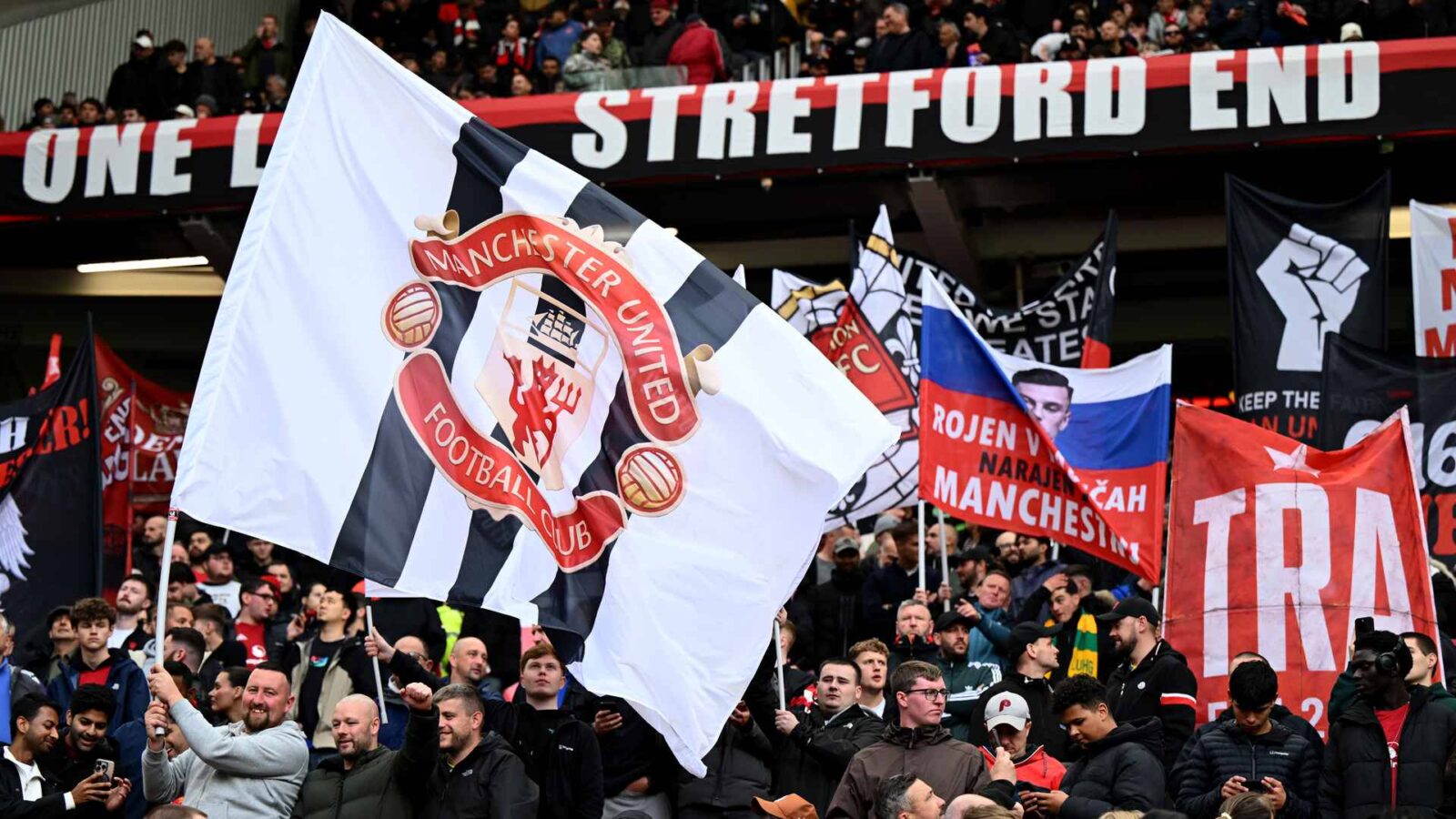
“You’d find yourself right at the front, grabbing your orange juice or your Wagon Wheel, or maybe a scalding Bovril from the tea urn behind you. The experience was just incredible. The atmosphere was electrifying. In those days, with my hair flowing, it felt like every hair on the back of your neck was standing up!”
Of course, it helped that United were the top team in the country at the time. However, just a few years after the Munich tragedy, both Gardner and Crook began to sense a gradual shift in the energy emanating from the Stretford End. While the following decades brought some of the terrace’s most joyful moments, they also ushered in some of the most harrowing.
1965-1989: WE ARE THE MANCHESTER BOYS
“I remained on the Stretford End until the early ’60s,” Digger recalls. “The Stretford End group started to dissolve around that time as some of us began dating and tying the knot. It was around then that the Stretford End began to feel more like a collective experience, similar to what we see today.”
Now able to attend matches independently, Crook and his friends from Stretford Grammar quickly carved out their own place on the ‘right side’ of the Stretford End, a trend that other groups of teenagers also followed.
“The sense of camaraderie was fantastic,” he reminisces. “You went with your friends and staked out your spot week after week. Nobody dared encroach on your territory, and if someone did, you’d make sure they knew to move along. Different sections had their own groups; the tunnel had its crew, while the left side was represented by fans from Ashton, Middleton, and Salford. Stretford and Wythenshawe claimed the right side. You were surrounded by your closest mates – some you’d grown up with, others you’d only see on weekends. The Stretford End was an enormous gathering place.”
With football legends Best, Law, and Charlton reaching their prime, the Stretford End became the place to be. Fans typically arrived hours before the match, allowing ample time for forging friendships, inventing chants, and, inevitably, stirring up mischief.
“It would get packed, and suddenly a gap would open up,” Crook recalls with a laugh, “and the challenge was to jump into that gap, leading to the crowd surging in. You could easily get stuck and crushed. But it was all in good fun at the time – you might suffer a cracked rib or two, but everyone just rolled with it!”
However, by the mid-’60s, more perilous incidents began to overshadow the friendly pushing and shoving, hinting at the hooliganism that would plague football during the ’70s and ’80s.
“In 1965, Everton attempted to ‘take’ the Stretford End,” Tony shares. “They surged up from the bottom, and one guy at the front whipped out a large sword from his coat. People understandably backed away, but soon enough, the brave ones charged towards them and drove them out of the ground. The ’60s were undeniably the beginning of the hooligan era.”
Yet, despite the potential for chaos, Crook acknowledges that this period also gave rise to some of his fondest memories as a Red. Yes, the Stretford End could be perilous, but its vibrant youthful spirit also helped generate some of the most remarkable atmospheres ever experienced in English football.